The Huffington Post
By Alissa Scheller
April 7, 2014
A growing number of women are victims of drug-related violence in Mexico. Sexual and gender-based violence against women in the country has a long history marked by lack legal intervention, and more recently, fueled by drug cartels and organized crime. Read more.

The MexicoBlog of the Americas Program, a fiscally sponsored program of the Center for Economic and Policy Research (CEPR), is written by Laura Carlsen. I monitor and analyze international press on Mexico, with a focus on security, immigration, human rights and social movements for peace and justice, from a feminist perspective. And sometimes I simply muse.
Showing posts with label drug war - bloodshed. Show all posts
Showing posts with label drug war - bloodshed. Show all posts
Apr 7, 2014


Apr 6, 2013
Mexico divided over memorial to drug-war victims
USAToday
ByAdriana Gomez Licon
Associated Press / April 5, 2013
MEXICO CITY (AP) — Mexico, a country suffering the turmoil of a drug war, can’t agree on how to honor the victims of a six-year assault on organized crime that has taken as many as 70,000 lives.
The government’s official monument was dedicated Friday, four months after its completion, in a public event where relatives of the missing chased after the dignitaries in tears, pleading for help in finding their loved ones.
Only some victims’ rights groups recognize the monument, while others picked an entirely different monument to place handkerchiefs painted with names and personal messages in protest of the official site, which does not bear a single victim’s name.
‘‘Other organizations asked us for other space because they’re against this one,’’ Interior Secretary Miguel Angel Osorio Chong said at the official dedication of the government monument, which consists of steel panels bearing quotes from famous writers and thinkers. ‘‘What took us so long was trying to get agreement among the groups, and we failed.’’ Read more.
ByAdriana Gomez Licon
Associated Press / April 5, 2013
MEXICO CITY (AP) — Mexico, a country suffering the turmoil of a drug war, can’t agree on how to honor the victims of a six-year assault on organized crime that has taken as many as 70,000 lives.
The government’s official monument was dedicated Friday, four months after its completion, in a public event where relatives of the missing chased after the dignitaries in tears, pleading for help in finding their loved ones.
Only some victims’ rights groups recognize the monument, while others picked an entirely different monument to place handkerchiefs painted with names and personal messages in protest of the official site, which does not bear a single victim’s name.
‘‘Other organizations asked us for other space because they’re against this one,’’ Interior Secretary Miguel Angel Osorio Chong said at the official dedication of the government monument, which consists of steel panels bearing quotes from famous writers and thinkers. ‘‘What took us so long was trying to get agreement among the groups, and we failed.’’ Read more.
Mar 23, 2013
Calderon says drug war was his legal duty
San Antonio Express/Jason Buch, Staff Writer
Updated 11:19 pm, Thursday, March 21, 2013
-
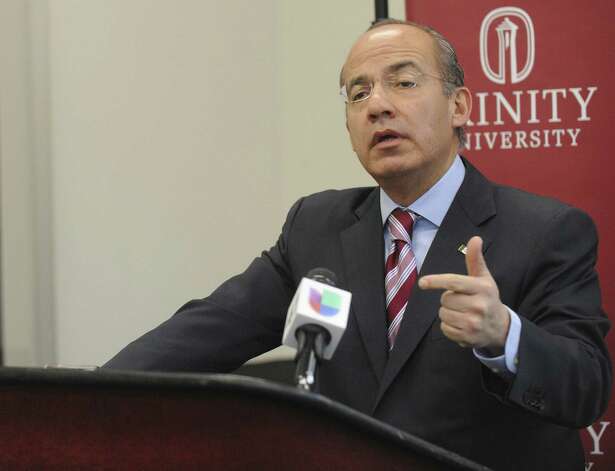 Photo: Billy Calzada, San Antonio Express-News
In a speech that focused primarily on his economic and social accomplishments, former Mexican President Felipe Calderón recalled a moment of doubt he felt as a member of the country's burgeoning opposition party.
Speaking Thursday night at Trinity University, Calderón said he confronted his father, a founding member of the National Action Party, with concerns about their campaign against the ruling Institutional Revolutionary Party.
His father responded, “We are doing this because it is the right thing to do,” Calderón said. “It is our moral duty to our country.”
Decades later, after his father's death, Calderón became the second president from his party, known by its Spanish acronym PAN. His six-year term, filled with controversy over his decision to use Mexico's military to confront organized crime, ended in November.
He's been accused of launching an unnecessarily bloody war against the cartels and allowing his forces to commit human rights abuses, but Calderón told the crowd that it was the same moral duty his father spoke of that led him to launch his war against Mexico's drug cartels.
Calderón acknowledged that abuses had taken place, but he insisted they happened against his orders and that perpetrators were prosecuted.
He characterized the cartels as criminal organizations involved in extortion and kidnapping, not just drug smuggling. He said that when he took office, criminals controlled the police in border states, such as Tamaulipas, the home state of one audience member who questioned his use of the military. Previous administrations, Calderón said, had chosen not to enforce the law.
“Either you enforce the law, which is your duty, or change the law,” he said in a news conference before the speech. “But you cannot ignore the law. In my opinion, enforcing the law is a very difficult task, but it is absolutely necessary. And if Mexico wants to be one of the developed nations, we need, as Mexican people, to have a rule-of-law country. Otherwise we will lose a lot of opportunity.”
One audience member questioned Calderón's characterization of the social and economic situation in Mexico, and another gently chided him for moving to the United States after his term ended. He's now teaching at Harvard's Kennedy School of Government in Cambridge, Mass.
The former president focused largely on Mexico's economic growth, especially in the manufacturing sector, and pension reform under his administration. Calderón also touted his expansion of the nation's education and health care systems. Such efforts, which Calderón characterized as “rebuilding the social fabric” of Mexico, were part of his effort to undermine the cartels.
Calderón said the U.S shares blame as well, allowing cash and money to flow south of the Rio Grande.
“What is crucial is to stop the flow of money going from the United States to Mexico,” he said. “In order to do that, the American society, Congress and government, have a moral obligation to find a way in which they could prevent the flow of that money.
“I don't want to say that the way to do that is to improve the money laundering regulations or to increase the strength of the American agencies or to explore market alternatives for drugs, but the point is as long as the American government and society are not able to stop the flow of money toward Mexico, Latin America, that will imply several years of violence ahead.”
jbuch@express-news.net
Speaking Thursday night at Trinity University, Calderón said he confronted his father, a founding member of the National Action Party, with concerns about their campaign against the ruling Institutional Revolutionary Party.
His father responded, “We are doing this because it is the right thing to do,” Calderón said. “It is our moral duty to our country.”
Decades later, after his father's death, Calderón became the second president from his party, known by its Spanish acronym PAN. His six-year term, filled with controversy over his decision to use Mexico's military to confront organized crime, ended in November.
He's been accused of launching an unnecessarily bloody war against the cartels and allowing his forces to commit human rights abuses, but Calderón told the crowd that it was the same moral duty his father spoke of that led him to launch his war against Mexico's drug cartels.
Calderón acknowledged that abuses had taken place, but he insisted they happened against his orders and that perpetrators were prosecuted.
He characterized the cartels as criminal organizations involved in extortion and kidnapping, not just drug smuggling. He said that when he took office, criminals controlled the police in border states, such as Tamaulipas, the home state of one audience member who questioned his use of the military. Previous administrations, Calderón said, had chosen not to enforce the law.
“Either you enforce the law, which is your duty, or change the law,” he said in a news conference before the speech. “But you cannot ignore the law. In my opinion, enforcing the law is a very difficult task, but it is absolutely necessary. And if Mexico wants to be one of the developed nations, we need, as Mexican people, to have a rule-of-law country. Otherwise we will lose a lot of opportunity.”
One audience member questioned Calderón's characterization of the social and economic situation in Mexico, and another gently chided him for moving to the United States after his term ended. He's now teaching at Harvard's Kennedy School of Government in Cambridge, Mass.
The former president focused largely on Mexico's economic growth, especially in the manufacturing sector, and pension reform under his administration. Calderón also touted his expansion of the nation's education and health care systems. Such efforts, which Calderón characterized as “rebuilding the social fabric” of Mexico, were part of his effort to undermine the cartels.
Calderón said the U.S shares blame as well, allowing cash and money to flow south of the Rio Grande.
“What is crucial is to stop the flow of money going from the United States to Mexico,” he said. “In order to do that, the American society, Congress and government, have a moral obligation to find a way in which they could prevent the flow of that money.
“I don't want to say that the way to do that is to improve the money laundering regulations or to increase the strength of the American agencies or to explore market alternatives for drugs, but the point is as long as the American government and society are not able to stop the flow of money toward Mexico, Latin America, that will imply several years of violence ahead.”
jbuch@express-news.net
Read more: http://www.mysanantonio.com/news/local_news/article/Calderon-says-drug-war-was-his-legal-duty-4375166.php#ixzz2ON06SdX3
Mar 15, 2013
An Ugly Truth in the War on Drugs
The NY Times
By Fernando Henrique Cardoso and Ruth Dreifuss
Published: March 10, 2013
This week, representatives from many nations will gather at the annual meeting of the United Nations Commission on Narcotic Drugs in Vienna to determine the appropriate course of the international response to illicit drugs. Delegates will debate multiple resolutions while ignoring a truth that goes to the core of current drug policy: human rights abuses in the war on drugs are widespread and systematic.
Consider these numbers: Hundreds of thousands of people locked in detention centers and subject to violent punishments. Millions imprisoned. Hundreds hanged, shot or beheaded. Tens of thousands killed by government forces and non-state actors. Thousands beaten and abused to extract information, and abused in government or private “treatment” centers. Millions denied life-saving medicines. These are alarming figures, but campaigns to address them have been slow and drug control has received little attention from the mainstream human rights movement.
This is a perfect storm for people who use drugs, especially those experiencing dependency, and those involved in the drug trade, whether growers, couriers or sellers. When people are dehumanized we know from experience that abuses against them are more likely. We know also that those abuses are less likely to be addressed because fewer people care. Read more.
By Fernando Henrique Cardoso and Ruth Dreifuss
Published: March 10, 2013
This week, representatives from many nations will gather at the annual meeting of the United Nations Commission on Narcotic Drugs in Vienna to determine the appropriate course of the international response to illicit drugs. Delegates will debate multiple resolutions while ignoring a truth that goes to the core of current drug policy: human rights abuses in the war on drugs are widespread and systematic.
Consider these numbers: Hundreds of thousands of people locked in detention centers and subject to violent punishments. Millions imprisoned. Hundreds hanged, shot or beheaded. Tens of thousands killed by government forces and non-state actors. Thousands beaten and abused to extract information, and abused in government or private “treatment” centers. Millions denied life-saving medicines. These are alarming figures, but campaigns to address them have been slow and drug control has received little attention from the mainstream human rights movement.
This is a perfect storm for people who use drugs, especially those experiencing dependency, and those involved in the drug trade, whether growers, couriers or sellers. When people are dehumanized we know from experience that abuses against them are more likely. We know also that those abuses are less likely to be addressed because fewer people care. Read more.
Feb 2, 2013
A quieter drug war in Mexico, but no less deadly
The Washington Post
By Nick Miroff, Published: February 1
MEXICO CITY — As a tactical matter, the gangsters and government security forces fighting Mexico’s drug war have typically opted for the spectacular over the subtle.
Massacres, beheadings and other unspeakable cruelties became cartels’ preferred form of violence. In response, the government sent masked troops with machine guns to patrol Mexico’s streets and paraded its captured drug suspects on television like hunting trophies.
But in the past few months, that has changed. Mexico’s drug war has gone quiet.
Not less lethal. Just less loud.
The country’s drug-related homicide numbers remain essentially undiminished. More than 12,000 people were murdered last year in gangland violence, according to the latest Mexican media tallies, roughly the same number that were slain in 2010 and 2011. Read more.
By Nick Miroff, Published: February 1
MEXICO CITY — As a tactical matter, the gangsters and government security forces fighting Mexico’s drug war have typically opted for the spectacular over the subtle.
Massacres, beheadings and other unspeakable cruelties became cartels’ preferred form of violence. In response, the government sent masked troops with machine guns to patrol Mexico’s streets and paraded its captured drug suspects on television like hunting trophies.
But in the past few months, that has changed. Mexico’s drug war has gone quiet.
Not less lethal. Just less loud.
The country’s drug-related homicide numbers remain essentially undiminished. More than 12,000 people were murdered last year in gangland violence, according to the latest Mexican media tallies, roughly the same number that were slain in 2010 and 2011. Read more.
Jan 24, 2013
Mexico's Drug War Taints Calderon's Harvard Appointment
By Andrew O'Reilly
Published January 18, 2013
Fox News Latino
For centuries, Harvard Yard has been a safe haven for aspiring minds, intellectuals and world leaders who come to teach, study and learn in peace.
But former Mexican President Felipe Calderón may not find much serenity during his time on campus.
The controversial former Mexican leader has yet to begin his one-year teaching appointment at the Kennedy School of Government and already he faces opposition from groups on both sides of the border.
The online petition site Change.Org has collected nearly 33,000 signatures in opposition to Harvard’s appointment of Calderón. And Mexican political activist and poet Javier Sicilia sent a letter to the university, calling the former president’s appointment an affront to the victims of the bloodshed in Mexico. Read more.
Published January 18, 2013
Fox News Latino
For centuries, Harvard Yard has been a safe haven for aspiring minds, intellectuals and world leaders who come to teach, study and learn in peace.
But former Mexican President Felipe Calderón may not find much serenity during his time on campus.
The controversial former Mexican leader has yet to begin his one-year teaching appointment at the Kennedy School of Government and already he faces opposition from groups on both sides of the border.
The online petition site Change.Org has collected nearly 33,000 signatures in opposition to Harvard’s appointment of Calderón. And Mexican political activist and poet Javier Sicilia sent a letter to the university, calling the former president’s appointment an affront to the victims of the bloodshed in Mexico. Read more.
Jan 16, 2013
Obama's Speech on Gun Control: Can the plan reduce violence in Mexico?
Today, President Obama gave a moving and hard-hitting speech to unveil his package of 23 actions to stem gun violence, along with three requests for Congressional action. The speech was streamed live on www.whitehouse.gov/live
In some ways, the speech and the actions went beyond what many expected. The call to reinstate the assault weapons ban--a decision that lies in Congress--shows a second-term president ready to speak his mind on an issue that has come to the fore after massacres across the country.
Obama attempted to ground the new proposals in surveys showing broad public support for more gun control, portraying the powerful gun lobbies as not representative of majority views. He stressed the human costs of gun violence by describing details of the victims lives, especially the children of Sandy Hook, and appealing to a universal concern for children's safety. Four young people who wrote him about there concerns accompanied the president on stage.
In the speech, President Obama detailed three measures required of Congress and mentioned a few of his executive measures.
The three specific requests of Congress are:
In some ways, the speech and the actions went beyond what many expected. The call to reinstate the assault weapons ban--a decision that lies in Congress--shows a second-term president ready to speak his mind on an issue that has come to the fore after massacres across the country.
Obama attempted to ground the new proposals in surveys showing broad public support for more gun control, portraying the powerful gun lobbies as not representative of majority views. He stressed the human costs of gun violence by describing details of the victims lives, especially the children of Sandy Hook, and appealing to a universal concern for children's safety. Four young people who wrote him about there concerns accompanied the president on stage.
In the speech, President Obama detailed three measures required of Congress and mentioned a few of his executive measures.
The three specific requests of Congress are:
- Legislation to require a universal background check on all gun buyers. Obama noted that existing background checks have kept some 1.5 million guns from ending up in the hands of potentially irresponsible buyers. He noted that one survey found that 70% of NRA members favor universal background checks.
- Restore the ban on military-style assault weapons and instate a 10-round limit for ammunition magazines. Obama stated that the shooter in the July 20, 2012 massacre in an Aurora, Colorado movie theater used an assault weapon with a high-capacity magazine that enabled him to shoot 70 people, killing 12, in minutes. "Weapons designed for the theater of war have no place in a movie theater," he said.
- "Help, rather than hinder law enforcement", by getting tough on people who buy guns to sell to criminals. He did not refer to specific legislative changes here, but instead to the need to confirm the director of the Alcohol, Tobacco and Firearms Bureau (ATF), the agency charged with overseeing arms sales and preventing smuggling. Obama has nominated acting director Todd Jones.
He also said he will direct the Center for Disease Control to conduct research into the causes of violence in our society. Noting that there has been opposition to this type of research and commenting acidly that "no one benefits from ignorance", Obama called for studies that scientifically measure the impact of violent videos and other imagery on young minds.
Here are the 23 actions that the President signed today, not all of which were included in the speech, according to the White House as reported by news sources:
2. "Address unnecessary legal barriers, particularly relating to the Health Insurance Portability and Accountability Act, that may prevent states from making information available to the background check system."
3. "Improve incentives for states to share information with the background check system."
4. "Direct the attorney general to review categories of individuals prohibited from having a gun to make sure dangerous people are not slipping through the cracks."
5. "Propose rulemaking to give law enforcement the ability to run a full background check on an individual before returning a seized gun."
6. "Publish a letter from ATF to federally licensed gun dealers providing guidance on how to run background checks for private sellers."
7. "Launch a national safe and responsible gun ownership campaign."
8. "Review safety standards for gun locks and gun safes (Consumer Product Safety Commission)."
9. "Issue a presidential Memorandum to require federal law enforcement to trace guns recovered in criminal investigations."
10. "Release a DOJ report analyzing information on lost and stolen guns and make it widely available to law enforcement."
11. "Nominate an ATF director."
12. "Provide law enforcement, first responders, and school officials with proper training for active shooter situations."
13. "Maximize enforcement efforts to prevent gun violence and prosecute gun crime."
14. "Issue a presidential memorandum directing the Centers for Disease Control to research the causes and prevention of gun violence."
15. "Direct the attorney general to issue a report on the availability and most effective use of new gun safety technologies and challenge the private sector to develop innovative technologies."
16. "Clarify that the Affordable Care Act does not prohibit doctors asking their patients about guns in their homes."
17. "Release a letter to health care providers clarifying that no federal law prohibits them from reporting threats of violence to law enforcement authorities."
18. "Provide incentives for schools to hire school resource officers."
19. "Develop model emergency response plans for schools, houses of worship and institutions of higher education."
20. "Release a letter to state health officials clarifying the scope of mental health services that Medicaid plans must cover."
21. "Finalize regulations clarifying essential health benefits and parity requirements within ACA exchanges."
22. "Commit to finalizing mental health parity regulations."
23. "Launch a national dialogue led by Secretaries Sebelius and Duncan on mental health."
With the plan on the table, the battle begins. Obama called on the U.S. public to support the measures and begin pressure on Congressional representatives, emphasizing districts heavily influenced by gun lobbyists and organizations.
Will the new plan help reduce Mexico´s violence?
Mexico will be paying very close attention to this debate. From former president Calderon, who called for reinstatement of the assault weapon ban and an end to gun smuggling on the floor of the US Congress in May of 2011, to Mexico's Movement for Peace with Justice and Dignity during a caravan across the United States have called for stricter control on arms sales and trafficking because loose laws not only contribute to the mass shootings in the United States but also fuel drug war violence in Mexico as smugglers take high-power weapons over the border.
The Caravan called for:
"the President of the United States immediately prohibit the importation of assault weapons to the United States. Assault weapons are often smuggled into Mexico, and have also been used too many times against innocent civilians in the US. We also propose increasing the regulatory capacity of the Bureau of Alcohol, Tobacco and Firearms (ATF) in the border regions where the arms smuggling is concentrated, especially in border states like Arizona and Texas."
President Obama did not mention the effect of out-of-control weapons sales in the United States on its neighbor to the South.
It's understandable that with a major domestic battle looming, bringing Mexico into the mix might not be strategic. With the racism and xenophobia that characterize some segments of the press and population, mentioning Mexico in almost any context can cause polemics. Just take a look at the number of irate statements from Fox News and other right-wing outlets whenever Calderon called for reforming US gun laws to control smuggling.
But Obama could have, and should have, included some critical points that would reduce illegal cross-border smuggling in the context of US reforms.
A close look at the reforms shows that the first six points relate to background checks. Congress has to legislate to require universal background checks, so these measures attempt to fill gaps within the existing structure, with greater information sharing and rigorous enforcement and definition.
Actions 7-8, 15, 18 relate to public education and gun safety measures, and the development of the emergency response model.
Actions 9-11 and 14 announce additional efforts by federal law enforcement agencies to generate and share information on gun violence from the causes (CDC) to the source of guns. These include hiring of the ATF director.
Actions 12-13 regard stronger, more effective law enforcement. This includes nominating the ATF director, which he did with Jones. Some press articles have interpreted #12 as placing cops in schools--a terrible idea--but that has not so far been stated explicitly in the list or the public event. Action 18 refers to hiring "school resource officers"--whatever that means.
The rest of the actions include measures to prevent and spot threats within mental health services.
What does this mean for Mexico?
* Increased background checks will reduce smuggling. There is no question that greater vigilance over who is allowed to purchase guns, as Obama, stated both from licensed dealers and gun-show sellers, will make it more difficult for straw purchasers to buy for smugglers. These measures must be fully and actively supported.
* The most impact by far would be the ban on sale and possession of assault weapons. Cutting off the free circulation of these weapons in the United States would help dry up U.S. supply for smugglers. This will be vigorously opposed by gun proponents.
None of the demands put forward by a group of US and Mexican non-governmental organizations made it into the presidential actions. A petition signed by more than 50,000 people called to:
It's understandable that with a major domestic battle looming, bringing Mexico into the mix might not be strategic. With the racism and xenophobia that characterize some segments of the press and population, mentioning Mexico in almost any context can cause polemics. Just take a look at the number of irate statements from Fox News and other right-wing outlets whenever Calderon called for reforming US gun laws to control smuggling.
But Obama could have, and should have, included some critical points that would reduce illegal cross-border smuggling in the context of US reforms.
A close look at the reforms shows that the first six points relate to background checks. Congress has to legislate to require universal background checks, so these measures attempt to fill gaps within the existing structure, with greater information sharing and rigorous enforcement and definition.
Actions 7-8, 15, 18 relate to public education and gun safety measures, and the development of the emergency response model.
Actions 9-11 and 14 announce additional efforts by federal law enforcement agencies to generate and share information on gun violence from the causes (CDC) to the source of guns. These include hiring of the ATF director.
Actions 12-13 regard stronger, more effective law enforcement. This includes nominating the ATF director, which he did with Jones. Some press articles have interpreted #12 as placing cops in schools--a terrible idea--but that has not so far been stated explicitly in the list or the public event. Action 18 refers to hiring "school resource officers"--whatever that means.
The rest of the actions include measures to prevent and spot threats within mental health services.
What does this mean for Mexico?
* Increased background checks will reduce smuggling. There is no question that greater vigilance over who is allowed to purchase guns, as Obama, stated both from licensed dealers and gun-show sellers, will make it more difficult for straw purchasers to buy for smugglers. These measures must be fully and actively supported.
* The most impact by far would be the ban on sale and possession of assault weapons. Cutting off the free circulation of these weapons in the United States would help dry up U.S. supply for smugglers. This will be vigorously opposed by gun proponents.
None of the demands put forward by a group of US and Mexican non-governmental organizations made it into the presidential actions. A petition signed by more than 50,000 people called to:
- Immediately detain and prohibit the importation of assault weapons to the United States, because many of them are sent as contraband to Mexico.
- Order dealers to report to the Bureau of Alcohol, Tobacco, Firearms and Explosives (ATF) the sale of multiple assault rifles to the same person over a period of five days.
- Increase the regulatory capacity of the ATF in those regions of the United States that supply the weapons contraband to Mexico, especially in border states.
As to the demand for "increased regulatory capacity of the ATF", giving the agency more powers must be predicated on a
thorough review and clean-up within. After the ATF has a confirmed
director, it should immediately begin an overhaul of rules and practices,
including more reporting and regulation. This is particularly needed following the famously failed and illegal operation "Fast and Furious", which allowed guns to be smuggled to Mexican cartels.
It makes sense politically at this point to first consolidate the agency
and its leadership and then take on issues of giving it greater powers, since it has
become a lightening rod for right-wing criticism based on the Fast and Furious scandal.
The right to live without violence
The president knows what he's up against now. He laid it out in the speech (a speech worth listening to, by the way):
"Ask (your representatives) to do this and if they say no, ask them why not..." and added pointedly, "What's more important? Getting an A grade from the gun lobby that helps fund their campaigns or giving parents some peace of mind when they drop their child off for first grade?"
The National Rifle Association's influence in Congress remains strong and extends into international policy as well.
Just before signing the actions, Obama noted that mass shootings enabled in part by loose gun controls, are not only a tragedy but a violation of basic human rights. The right to assemble peacefully (for those shot in the theaters), the right to freedom of worship (for the sikh in Wisconsin) and basic rights to life and happiness are violated by violence.
In Mexico, this rights framework that incorporates and adds to the human tragedy, can help in understanding how to climb out of the morass of gun violence here by lending a greater sense of urgency to the issue. The right to live without violence places responsibility for ending the killings squarely within the realm of the state.
Mexico prohibits most gun ownership, but as always enforcement is the problem. If fewer guns come over the border, the nation could have a small, but important, aid in reducing the bloodshed that has become a hallmark of daily life since the drug war began.
In the United States, we must support these measures to protect our communities. But remember that the dynamics of violence are far more causal than the tools. A killer will find a way to kill.
In Mexico, today's plan comes as welcome news. But the black market for arms is international and "legitimate" arms in the hands of authorities are just as deadly when turned against the population as arms in the hands of criminals. Until the U.S. government abandons its support for Mexico's disastrous drug war embodied in the Merida Initiative foreign aid package, it continues to feed the dynamics of violence in Mexican border cities and throughout the country.
Jan 11, 2013
Mexico enacts law to compensate victims of crime
BBC: January 10, 2013
Mexican President Enrique Pena Nieto has enacted a law to trace and help thousands of victims caught up in drug violence and other crimes.
The bill sets up a compensation fund and establishes a national registry to record what happened to victims.
Some 70,000 people have died in drug violence since 2006, with at least several thousand more missing.
Campaign groups say the law is a first step but needs to go further to be effective.
The legislation was passed last April but was held up after the former President, Felipe Calderon, argued that it was flawed.
But Mr Pena Nieto, who took office on 1 December, signed the bill into law on Wednesday, saying it was an important step in recognising victims' rights.
"There are thousands of people who sadly have lost a loved one, their children, their spouses, their siblings. There are thousands of people who have suffered the havoc wrought by violence," he said. Read more.
Mexican President Enrique Pena Nieto has enacted a law to trace and help thousands of victims caught up in drug violence and other crimes.
The bill sets up a compensation fund and establishes a national registry to record what happened to victims.
Some 70,000 people have died in drug violence since 2006, with at least several thousand more missing.
Campaign groups say the law is a first step but needs to go further to be effective.
The legislation was passed last April but was held up after the former President, Felipe Calderon, argued that it was flawed.
But Mr Pena Nieto, who took office on 1 December, signed the bill into law on Wednesday, saying it was an important step in recognising victims' rights.
"There are thousands of people who sadly have lost a loved one, their children, their spouses, their siblings. There are thousands of people who have suffered the havoc wrought by violence," he said. Read more.
Nov 23, 2012
Mapping the Unidentified Victims of Mexico's Drug War
InSight Crime, Written by Geoffrey Ramsey Sunday, 18 November 2012
An investigative report by Milenio suggests that of the 60,000 people killed in the last six years in Mexico's fight against organized crime, nearly half have not been identified by the government. It also finds evidence that state officials may be tampering with the public record of these deaths.
The months-long investigation published in October found that at least 24,102 of the 60,000 Mexicans that have died in circumstances related to the fight against organized crime since 2006, have yet to be identified, and are classified by officials as "NN," ("ningun nombre," or no name). Below is a map compiled by the paper of the states with the highest reported concentrations of these unidentified victims.
Even more alarming, this is a conservative estimate. State officials were extremely uncooperative with the investigation. The state of Tamaulipas, for example, simply refused to release any data on the number of NNs to the newspaper, saying that it was a federal matter and not the state's responsibility.
The government of Veracruz also put up a fight against releasing the data to Milenio, arguing that to do so would put its officials "at risk" and potentially violate the privacy of the victims. While a freedom of information request filed by the paper was approved in Mexican courts, the state has yet to provide a comprehensive list of cases of unidentified murder victims. The local governments 30 of 212 municipalities in Veracruz did provide information to Milenio, however; according to this data, it was the state with the most unidentified victims in the country, with 5,245. Read more.
An investigative report by Milenio suggests that of the 60,000 people killed in the last six years in Mexico's fight against organized crime, nearly half have not been identified by the government. It also finds evidence that state officials may be tampering with the public record of these deaths.
The months-long investigation published in October found that at least 24,102 of the 60,000 Mexicans that have died in circumstances related to the fight against organized crime since 2006, have yet to be identified, and are classified by officials as "NN," ("ningun nombre," or no name). Below is a map compiled by the paper of the states with the highest reported concentrations of these unidentified victims.
Even more alarming, this is a conservative estimate. State officials were extremely uncooperative with the investigation. The state of Tamaulipas, for example, simply refused to release any data on the number of NNs to the newspaper, saying that it was a federal matter and not the state's responsibility.
The government of Veracruz also put up a fight against releasing the data to Milenio, arguing that to do so would put its officials "at risk" and potentially violate the privacy of the victims. While a freedom of information request filed by the paper was approved in Mexican courts, the state has yet to provide a comprehensive list of cases of unidentified murder victims. The local governments 30 of 212 municipalities in Veracruz did provide information to Milenio, however; according to this data, it was the state with the most unidentified victims in the country, with 5,245. Read more.
Jun 23, 2012
Killings Curb Reporting of Mexican Crime Wave
NYT: XALAPA, MEXICO -- Mexico for several years has been one of the most dangerous countries in
the world for journalists, with 45 killed or missing since 2007, according to one tally. But Veracruz State is considered the most dangerous
patch of all in which to report the news. The violence here has gone
off the charts, with at least nine journalists killed in the past year
and a half.
Veracruz, with prime drug and migrant trafficking routes crisscrossing
the state, plus a busy port on the Gulf of Mexico known for smuggling
contraband, has erupted into a battleground, as two of the most powerful
organized crime groups, the Zetas and the Sinaloa cartel, fight for
dominance.
Read moreJun 13, 2012
Mexico Ranks at Bottom of Global Peace index
Mexico came out at the bottom of the pack on the 2012 Global Peace Index (GPI), released yesterday, garnering slot 135 out of a group of 158 countries. The GPI ranks nations on a scale of 1-5 based on 23 indicators associated with the absence of violence, with 5 being the least peaceful. Mexico garnered fives in "violent crime" and "deaths from internal conflict". Other critical areas include fours in "political terror", "homicides", "access to weapons" and "perception of criminality".
The world, and Latin America in particular, rose overall in peacefulness during the last year. Mexico is the notable exception, dropping from 105 out of 148 in 2010.
Mexico´s ranking comes as no surprise to people here. Most of the other countries in the lowest 15% are experiencing open conflict, with Somalia as the most violent country, followed by Afghanistan and Sudan. Mexico's ranking reflects the degree to which its internal conflict cause by the war on drugs has risen in impact.
The report concludes with this statement on the economic cost of violence:
The world, and Latin America in particular, rose overall in peacefulness during the last year. Mexico is the notable exception, dropping from 105 out of 148 in 2010.
Mexico´s ranking comes as no surprise to people here. Most of the other countries in the lowest 15% are experiencing open conflict, with Somalia as the most violent country, followed by Afghanistan and Sudan. Mexico's ranking reflects the degree to which its internal conflict cause by the war on drugs has risen in impact.
The report concludes with this statement on the economic cost of violence:
If the world was completely peaceful in 2011, the additional economic impact would have been an estimated US$9 trillion (equal to the size of the German and Japanese economies combined). While a total elimination of violence may not be possible an achievable 25% reduction in violence could reap a peace dividend of at least US$2.25 trillion. This amount would easily cover the European Financial Stability Facility’s $1 trillion allocation to deal with the European sovereign debt crisis while also covering the yearly cost of achieving the Millennium Development Goals.
Mar 21, 2012
Drug War: Mexico police find 10 heads outside slaughterhouse
LA Daily News: "Mexican authorities have found 10 severed heads dumped outside a slaughterhouse in a town in northern Guerrero state. They are still looking for the bodies.
A statement from the Teloloapan police says the heads of seven men and three women were left with a message that appears to threaten the La Familia Michoacana drug cartel. The warning says: "This is going to happen to all those who support the FM."" read more
A statement from the Teloloapan police says the heads of seven men and three women were left with a message that appears to threaten the La Familia Michoacana drug cartel. The warning says: "This is going to happen to all those who support the FM."" read more
Mar 17, 2012
Drug War Violence: Wave of violence leaves 29 dead yesterday
La Jornada: "Authorities reported 29 homicides related to organized crime in eight states yesterday, March 16. In Durango, six men were killed. ...There were seven deaths in Chihuahua and five in Sinaloa. There were three deaths in Veracruz, two in Sonora, two in Nayarit, and one in Nuevo Leon, where the corpse of a child between 12 and 14 years was found with signs of torture and two bullets in his head. There was one death in Coahuila." Spanish original
Mar 13, 2012
Drug War Bloodshed: Drug War-Related Homicides In The US Average At Least 1,100 a Year
Salem-News: " The number of people murdered in the drug war inside the United States between 2006 and 2010 exceeds the US-troop death toll in the Iraq War since it was launched in 2003, according to a Narco News analysis of FBI crime statistics.
The US drug-war homicide tally also is nearly three times greater than the number of US soldiers killed in Afghanistan since the first shots were fired in that war in 2001, the Narco News analysis shows.
And that US drug-war murder total — nearly 5,700 people cut down on US soil over the 5-year period examined by Narco News — very likely undercounts significantly the extent of the bloodshed.
Vice President Joe Biden early this week while visiting Mexico made it clear, according to media reports, that “there is no possibility” that the United States would entertain the notion of ending drug prohibition, despite a growing call among Latin American leaders and citizens of those countries for a new course in the bloody drug war, one that includes a discussion of drug legalization." read more
The US drug-war homicide tally also is nearly three times greater than the number of US soldiers killed in Afghanistan since the first shots were fired in that war in 2001, the Narco News analysis shows.
And that US drug-war murder total — nearly 5,700 people cut down on US soil over the 5-year period examined by Narco News — very likely undercounts significantly the extent of the bloodshed.
Vice President Joe Biden early this week while visiting Mexico made it clear, according to media reports, that “there is no possibility” that the United States would entertain the notion of ending drug prohibition, despite a growing call among Latin American leaders and citizens of those countries for a new course in the bloody drug war, one that includes a discussion of drug legalization." read more
Mar 9, 2012
Drug War Bloodshed: Mutilated bodies of four students found in central Mexico
Reuters/chicagotribune.com: " Police found on Thursday the mutilated bodies of four teenagers inside plastic bags dumped on a street in a residential area of Cuernavaca, a weekend retreat 84 kilometres (52 miles) south of Mexico City. The state attorney's office said a threatening message against an unnamed criminal group was found near the bodies of the male students, aged 13 to 17." read more
Mar 8, 2012
Drug War Bloodshed: At least 19 bodies found in Mexico’s latest mass graves
Channel 6 News: " At least nineteen bodies were recovered on Wednesday from three newly discovered mass graves in northern Mexico, local authorities said on Thursday. They are believed to be victims of the Mexican drug war. The mass graves were found ... in the municipality of Juarez, located some 30 kilometers (18.6 miles) northeast of Monterrey, the capital of Nuevo Leon state.
Local authorities said the graves were found after preliminary investigative reports were filed following the arrest of several suspected members of the 'Los Zetas' drug cartel. The mass graves were reportedly used to dump the bodies of victims of kidnapping and extortion cases, as well as members of rival groups." read more
Local authorities said the graves were found after preliminary investigative reports were filed following the arrest of several suspected members of the 'Los Zetas' drug cartel. The mass graves were reportedly used to dump the bodies of victims of kidnapping and extortion cases, as well as members of rival groups." read more
Mar 4, 2012
Drug War Bloodshed: Police Commander Murdered in Northern Mexico
Latin American Herald Tribune: "The Nuevo Leon State Investigations Agency, or AEI, commander in San Pedro, a town in northern Mexico, was killed by gunmen, officials said.
Maj. Antonio Montiel Alvarez was gunned down around 10:30 p.m. Friday on a road in Benito Juarez, a city on the east side of the Monterrey metropolitan area, Nuevo Leon state Security Council spokesman Jorge Domene said." read more
Maj. Antonio Montiel Alvarez was gunned down around 10:30 p.m. Friday on a road in Benito Juarez, a city on the east side of the Monterrey metropolitan area, Nuevo Leon state Security Council spokesman Jorge Domene said." read more
Feb 21, 2012
Drug War: Interactive Map Charts Mexico's Drug War
Forbes: "This interactive map lets you compare homicides and drug-related homicides, with the option to examine marijuana, opium, and drug-lab-related homicides. If you click on a bubble, you can see the number of murders over time, dating back to 2004. Important events are highlighted on that time line. You can also draw a shape on the map to look at a particular region." see map
Feb 8, 2012
Drug War Bloodshed: Mexican navy finds 10 bodies in mass grave
AP/ContraCostaTimes.com: "A suspected member of the Zetas drug gang has led Mexican authorities to a mass grave site at two ranches in the Gulf coast state of Veracruz, the navy said Wednesday." read more
Feb 4, 2012
Drug War: Violence in Mexico
Mexican embassy spokesman, Ricardo Alday, responds to a New York Times article .
NYTimes.com: "“Mexico Drug War Bloodies Areas Thought Safe” (front page, Jan. 19) provides a sensationalist vision of what is actually happening in Mexico. I disagree with the essential premise of the article: that criminal violence has expanded geographically.
Deaths related to rivalries between criminal gangs remain geographically concentrated. From January to September 2011, 55.7 percent of all deaths related to rivalry between criminal organizations took place in just 5 out of 32 states: Chihuahua, Sinaloa, Guerrero, Tamaulipas and Nuevo Leon.
Your article cherry-picks data in the case of municipalities. We simply do not agree that violence is spreading to more cities: 91.6 percent of the country’s 2,441 municipalities do not experience a serious public security problem, defined by the benchmark of more than 10 organized crime-related homicides a year." read more
Deaths related to rivalries between criminal gangs remain geographically concentrated. From January to September 2011, 55.7 percent of all deaths related to rivalry between criminal organizations took place in just 5 out of 32 states: Chihuahua, Sinaloa, Guerrero, Tamaulipas and Nuevo Leon.
Your article cherry-picks data in the case of municipalities. We simply do not agree that violence is spreading to more cities: 91.6 percent of the country’s 2,441 municipalities do not experience a serious public security problem, defined by the benchmark of more than 10 organized crime-related homicides a year." read more
Subscribe to:
Posts (Atom)