Huffington Post
By Katherine Corcoran
Mexico City - With the capture of two top drug lords in little more than a month, the new government of President Enrique Pena Nieto is following an old strategy it openly criticized for causing more violence and crime.
Mario Armando Ramirez Trevino, a top leader of Mexico's Gulf Cartel, was detained Saturday in a military operation near the Texas border, just weeks after the arrest of the leader of the brutal Zetas cartel near another border city, Nuevo Laredo.
Interior Secretary Miguel Angel Osorio Chong took his post in December saying the strategy of former President Felipe Calderon to take out cartel leaders only made drug gangs more dangerous and violent. The new administration would focus less on leaders and more on reducing violence, he said.
Yet the new strategy appears almost identical to the old. The captures of Ramirez and top Zeta Miguel Angel Trevino Morales could cause a new spike in violence with battles over leadership of Mexico's two major cartels. Read more.

The MexicoBlog of the Americas Program, a fiscally sponsored program of the Center for Economic and Policy Research (CEPR), is written by Laura Carlsen. I monitor and analyze international press on Mexico, with a focus on security, immigration, human rights and social movements for peace and justice, from a feminist perspective. And sometimes I simply muse.
Showing posts with label drug war - strategy. Show all posts
Showing posts with label drug war - strategy. Show all posts


Apr 16, 2013
Mexico government downplays deadly violence
The Mexico propaganda campaign has some success as think tanks and newspapers ignore facts on the ground and promote discussion of the economy over violence.
Los Angeles Times
By Tracy Wilkinson and Cecilia Sanchez
April 11, 2013|
The new government of Mexican President Enrique Peña Nieto has sought to downplay the deadly violence that has long haunted much of Mexico and that he repeatedly pledged to reduce.
But the country's killers aren't cooperating.
Newly released statistics indicate the number of homicides related to drug trafficking and other organized crime are only marginally changed from the same period last year, a blow to the government's attempts to recast Mexico's image.
On Wednesday, Interior Minister Miguel Angel Osorio Chong said 1,101 people were killed in March. That brings the official total under the Peña Nieto administration, which began in December, to 4,249, or roughly 35 a day, and close to the rate during the last year of the administration of President Felipe Calderon. Read more.
Los Angeles Times
By Tracy Wilkinson and Cecilia Sanchez
April 11, 2013|
The new government of Mexican President Enrique Peña Nieto has sought to downplay the deadly violence that has long haunted much of Mexico and that he repeatedly pledged to reduce.
But the country's killers aren't cooperating.
Newly released statistics indicate the number of homicides related to drug trafficking and other organized crime are only marginally changed from the same period last year, a blow to the government's attempts to recast Mexico's image.
On Wednesday, Interior Minister Miguel Angel Osorio Chong said 1,101 people were killed in March. That brings the official total under the Peña Nieto administration, which began in December, to 4,249, or roughly 35 a day, and close to the rate during the last year of the administration of President Felipe Calderon. Read more.
Mar 23, 2013
Calderon says drug war was his legal duty
San Antonio Express/Jason Buch, Staff Writer
Updated 11:19 pm, Thursday, March 21, 2013
-
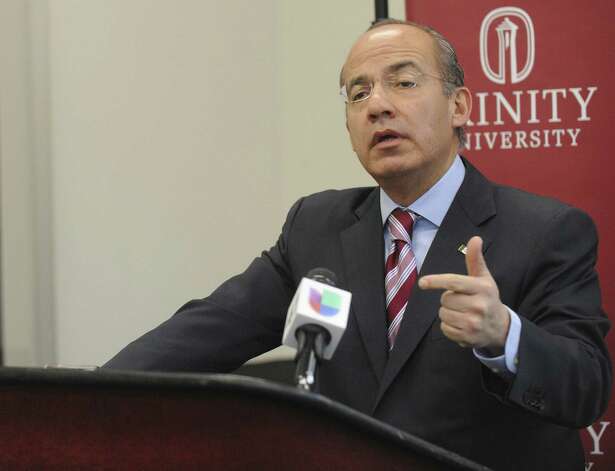 Photo: Billy Calzada, San Antonio Express-News
In a speech that focused primarily on his economic and social accomplishments, former Mexican President Felipe Calderón recalled a moment of doubt he felt as a member of the country's burgeoning opposition party.
Speaking Thursday night at Trinity University, Calderón said he confronted his father, a founding member of the National Action Party, with concerns about their campaign against the ruling Institutional Revolutionary Party.
His father responded, “We are doing this because it is the right thing to do,” Calderón said. “It is our moral duty to our country.”
Decades later, after his father's death, Calderón became the second president from his party, known by its Spanish acronym PAN. His six-year term, filled with controversy over his decision to use Mexico's military to confront organized crime, ended in November.
He's been accused of launching an unnecessarily bloody war against the cartels and allowing his forces to commit human rights abuses, but Calderón told the crowd that it was the same moral duty his father spoke of that led him to launch his war against Mexico's drug cartels.
Calderón acknowledged that abuses had taken place, but he insisted they happened against his orders and that perpetrators were prosecuted.
He characterized the cartels as criminal organizations involved in extortion and kidnapping, not just drug smuggling. He said that when he took office, criminals controlled the police in border states, such as Tamaulipas, the home state of one audience member who questioned his use of the military. Previous administrations, Calderón said, had chosen not to enforce the law.
“Either you enforce the law, which is your duty, or change the law,” he said in a news conference before the speech. “But you cannot ignore the law. In my opinion, enforcing the law is a very difficult task, but it is absolutely necessary. And if Mexico wants to be one of the developed nations, we need, as Mexican people, to have a rule-of-law country. Otherwise we will lose a lot of opportunity.”
One audience member questioned Calderón's characterization of the social and economic situation in Mexico, and another gently chided him for moving to the United States after his term ended. He's now teaching at Harvard's Kennedy School of Government in Cambridge, Mass.
The former president focused largely on Mexico's economic growth, especially in the manufacturing sector, and pension reform under his administration. Calderón also touted his expansion of the nation's education and health care systems. Such efforts, which Calderón characterized as “rebuilding the social fabric” of Mexico, were part of his effort to undermine the cartels.
Calderón said the U.S shares blame as well, allowing cash and money to flow south of the Rio Grande.
“What is crucial is to stop the flow of money going from the United States to Mexico,” he said. “In order to do that, the American society, Congress and government, have a moral obligation to find a way in which they could prevent the flow of that money.
“I don't want to say that the way to do that is to improve the money laundering regulations or to increase the strength of the American agencies or to explore market alternatives for drugs, but the point is as long as the American government and society are not able to stop the flow of money toward Mexico, Latin America, that will imply several years of violence ahead.”
jbuch@express-news.net
Speaking Thursday night at Trinity University, Calderón said he confronted his father, a founding member of the National Action Party, with concerns about their campaign against the ruling Institutional Revolutionary Party.
His father responded, “We are doing this because it is the right thing to do,” Calderón said. “It is our moral duty to our country.”
Decades later, after his father's death, Calderón became the second president from his party, known by its Spanish acronym PAN. His six-year term, filled with controversy over his decision to use Mexico's military to confront organized crime, ended in November.
He's been accused of launching an unnecessarily bloody war against the cartels and allowing his forces to commit human rights abuses, but Calderón told the crowd that it was the same moral duty his father spoke of that led him to launch his war against Mexico's drug cartels.
Calderón acknowledged that abuses had taken place, but he insisted they happened against his orders and that perpetrators were prosecuted.
He characterized the cartels as criminal organizations involved in extortion and kidnapping, not just drug smuggling. He said that when he took office, criminals controlled the police in border states, such as Tamaulipas, the home state of one audience member who questioned his use of the military. Previous administrations, Calderón said, had chosen not to enforce the law.
“Either you enforce the law, which is your duty, or change the law,” he said in a news conference before the speech. “But you cannot ignore the law. In my opinion, enforcing the law is a very difficult task, but it is absolutely necessary. And if Mexico wants to be one of the developed nations, we need, as Mexican people, to have a rule-of-law country. Otherwise we will lose a lot of opportunity.”
One audience member questioned Calderón's characterization of the social and economic situation in Mexico, and another gently chided him for moving to the United States after his term ended. He's now teaching at Harvard's Kennedy School of Government in Cambridge, Mass.
The former president focused largely on Mexico's economic growth, especially in the manufacturing sector, and pension reform under his administration. Calderón also touted his expansion of the nation's education and health care systems. Such efforts, which Calderón characterized as “rebuilding the social fabric” of Mexico, were part of his effort to undermine the cartels.
Calderón said the U.S shares blame as well, allowing cash and money to flow south of the Rio Grande.
“What is crucial is to stop the flow of money going from the United States to Mexico,” he said. “In order to do that, the American society, Congress and government, have a moral obligation to find a way in which they could prevent the flow of that money.
“I don't want to say that the way to do that is to improve the money laundering regulations or to increase the strength of the American agencies or to explore market alternatives for drugs, but the point is as long as the American government and society are not able to stop the flow of money toward Mexico, Latin America, that will imply several years of violence ahead.”
jbuch@express-news.net
Read more: http://www.mysanantonio.com/news/local_news/article/Calderon-says-drug-war-was-his-legal-duty-4375166.php#ixzz2ON06SdX3
Feb 28, 2013
Why Killing Kingpins Won't Stop Mexico's Drug Cartels
The Atlantic
By Keegan Hamilton
February 27, 2013
The rumor started Thursday afternoon when the newspaper Prensa Libre reported that several narcos were killed during shootout in Guatemala's remote Petén region. Interior Minister Mauricio Lopez said one of the corpses was "physically very similar" to Joaquin "El Chapo" Guzmán, top boss of Mexico's Sinaloa cartel. Other outlets, including the unfiltered drug war diary Blog del Narco, spread the word on Twitter, piquing the interest of the international press, and sending Mexican and Guatemalan officials scrambling to confirm the powerful drug lord's purported demise.
The rumor was soon thoroughly debunked. There was no shootout, let alone one that claimed the life of the modern day Pablo Escobar. (Lopez, the Interior Minister, later apologized for the "misunderstanding" and blamed contradictory reports for the confusion.) Not only is El Chapo still very much alive, his legend has grown larger than ever. Already a billionaire according to Forbes, the Sinaloa capo has supplanted Osama bin Laden as the State Department's top international target, and the Chicago Crime Commission recently named him Public Enemy No. 1, a title originally reserved for Al Capone. Read more.
By Keegan Hamilton
February 27, 2013
The rumor started Thursday afternoon when the newspaper Prensa Libre reported that several narcos were killed during shootout in Guatemala's remote Petén region. Interior Minister Mauricio Lopez said one of the corpses was "physically very similar" to Joaquin "El Chapo" Guzmán, top boss of Mexico's Sinaloa cartel. Other outlets, including the unfiltered drug war diary Blog del Narco, spread the word on Twitter, piquing the interest of the international press, and sending Mexican and Guatemalan officials scrambling to confirm the powerful drug lord's purported demise.
The rumor was soon thoroughly debunked. There was no shootout, let alone one that claimed the life of the modern day Pablo Escobar. (Lopez, the Interior Minister, later apologized for the "misunderstanding" and blamed contradictory reports for the confusion.) Not only is El Chapo still very much alive, his legend has grown larger than ever. Already a billionaire according to Forbes, the Sinaloa capo has supplanted Osama bin Laden as the State Department's top international target, and the Chicago Crime Commission recently named him Public Enemy No. 1, a title originally reserved for Al Capone. Read more.
Feb 15, 2013
Mexico Seeks US Help for Anti-Drug Social Programs
Associated Press
Mexico City, February 15, 2013
A top security official says Mexico will ask the U.S. to focus anti-drug aid more on social programs and prevention.
Mexican Assistant Interior Secretary Roberto Campa says only about 2 percent of the current $1.9 billion in American aid under the Merida Initiative is earmarked for social programs. Most goes for intelligence, transport and the training for Mexican law enforcement agencies.
Campa said Thursday the previous administration's social programs were poorly organized and late.
President Enrique Pena Nieto has pledged to focus less on armed conflict and more on addressing the underlying social issues that fuel the drug violence that has cost more than 70,000 lives since 2006.
That plan includes a $9.2 billion program to provide greater employment and educational opportunities for youths who otherwise might join cartels.
Mexico City, February 15, 2013
A top security official says Mexico will ask the U.S. to focus anti-drug aid more on social programs and prevention.
Mexican Assistant Interior Secretary Roberto Campa says only about 2 percent of the current $1.9 billion in American aid under the Merida Initiative is earmarked for social programs. Most goes for intelligence, transport and the training for Mexican law enforcement agencies.
Campa said Thursday the previous administration's social programs were poorly organized and late.
President Enrique Pena Nieto has pledged to focus less on armed conflict and more on addressing the underlying social issues that fuel the drug violence that has cost more than 70,000 lives since 2006.
That plan includes a $9.2 billion program to provide greater employment and educational opportunities for youths who otherwise might join cartels.
Feb 13, 2013
Mexico unveils new strategy in war on drugs and for preventing crime
The Guardian
February 13, 2013
Mexico's new administration has offered the first details of its new strategy in the country's war on drugs, saying the government will spend $9.2bn (£5.9bn) this year on social programmes to keep young people from joining criminal organisations in the 251 most violent towns and neighbourhoods across the country.
The government will flood those areas with spending on programmes ranging from road building to increasing school hours, President Enrique Peña Nieto and Miguel Ángel Osorio Chong, the interior secretary, told an audience in the central state of Aguascalientes.
"It's clear that we must put special emphasis on prevention, because we can't only keep employing more sophisticated weapons, better equipment, more police, a higher presence of the armed forces in the country as the only form of combating organised crime," Peña Nieto said. Read more.
February 13, 2013
Mexico's new administration has offered the first details of its new strategy in the country's war on drugs, saying the government will spend $9.2bn (£5.9bn) this year on social programmes to keep young people from joining criminal organisations in the 251 most violent towns and neighbourhoods across the country.
The government will flood those areas with spending on programmes ranging from road building to increasing school hours, President Enrique Peña Nieto and Miguel Ángel Osorio Chong, the interior secretary, told an audience in the central state of Aguascalientes.
"It's clear that we must put special emphasis on prevention, because we can't only keep employing more sophisticated weapons, better equipment, more police, a higher presence of the armed forces in the country as the only form of combating organised crime," Peña Nieto said. Read more.
Jan 24, 2013
Honoring Drug War Dead, and Spurring a Debate
The NY Times
By Randal Archibold
Published: January 23, 2013
MEXICO CITY — Reeling from a drug war that has killed tens of thousands and a boom in violent crime in general, Mexico has built a memorial to victims of violence. But like a crime scene still under investigation, it sits off limits behind white tarp, wrapped in questions and uncertainty.
A series of rusted metal slabs amid reflecting pools in a corner of Mexico City’s biggest park, the memorial now stands as an accidental metaphor for the fog and doubts that swirl around the country’s layered debates on violence and victimhood.
Rushed to completion by President Felipe Calderón, whose six-year term was overwhelmed by the explosion of violence, the site has not yet publicly opened. On Nov. 30, in Mr. Calderón’s last 90 minutes in office, his administration sent a short e-mail to reporters announcing that the memorial was complete and in the hands of the civic groups that had called for it.
But in fact the transfer of the military-owned site has been mired in bureaucratic delays, and there remains disagreement over who the victims are — particularly in the bloody war against drug cartels and other organized crime that has consumed the country. Read more.
By Randal Archibold
Published: January 23, 2013
MEXICO CITY — Reeling from a drug war that has killed tens of thousands and a boom in violent crime in general, Mexico has built a memorial to victims of violence. But like a crime scene still under investigation, it sits off limits behind white tarp, wrapped in questions and uncertainty.
A series of rusted metal slabs amid reflecting pools in a corner of Mexico City’s biggest park, the memorial now stands as an accidental metaphor for the fog and doubts that swirl around the country’s layered debates on violence and victimhood.
Rushed to completion by President Felipe Calderón, whose six-year term was overwhelmed by the explosion of violence, the site has not yet publicly opened. On Nov. 30, in Mr. Calderón’s last 90 minutes in office, his administration sent a short e-mail to reporters announcing that the memorial was complete and in the hands of the civic groups that had called for it.
But in fact the transfer of the military-owned site has been mired in bureaucratic delays, and there remains disagreement over who the victims are — particularly in the bloody war against drug cartels and other organized crime that has consumed the country. Read more.
Nov 30, 2012
Mexico’s new president to shift dialogue with U.S., from drugs to economy
Washington Post. By William Booth and Nick Miroff
November 30, 2012
MEXICO CITY — On the eve of his inauguration and his party’s return to power, Mexico’s incoming President Enrique Peña Nieto has vowed to reshape his country’s education, business and energy sectors in ways that could have profound effects on the United States.
A dynamic politician, from an old autocratic political party, Peña Nieto has said he wants to change the conversation about Mexico in the United States, away from headless torsos and drug cartels to trade and manufacturing.
Together with the United States, Peña Nieto and his top advisors say Mexico wants to drill more oil, assemble more cars and build “better, faster, smarter bridges” to grow the $1 billion a day commerce across the the 2,000-mile border, already the busiest crossing in the world.
Peña Nieto, who takes office Saturday, and his team say they are ready to help the Obama administration and U.S. Congress implement a guest worker program to regulate the flow of Mexican labor to the United States, where an estimated 6 million Mexicans live illegally. Read more.
November 30, 2012
MEXICO CITY — On the eve of his inauguration and his party’s return to power, Mexico’s incoming President Enrique Peña Nieto has vowed to reshape his country’s education, business and energy sectors in ways that could have profound effects on the United States.
A dynamic politician, from an old autocratic political party, Peña Nieto has said he wants to change the conversation about Mexico in the United States, away from headless torsos and drug cartels to trade and manufacturing.
Together with the United States, Peña Nieto and his top advisors say Mexico wants to drill more oil, assemble more cars and build “better, faster, smarter bridges” to grow the $1 billion a day commerce across the the 2,000-mile border, already the busiest crossing in the world.
Peña Nieto, who takes office Saturday, and his team say they are ready to help the Obama administration and U.S. Congress implement a guest worker program to regulate the flow of Mexican labor to the United States, where an estimated 6 million Mexicans live illegally. Read more.
Nov 20, 2012
Border Patrol agents hope program will stop teens from working with cartel
ABC15 CASA GRANDE, AZ - Border Patrol agents are hoping a program called Operation Detour will teach teens to say no to the cartel.
The program is similar to D.A.R.E., Drug Abuse Resistance Education, an earlier program also targeted at teens.
In the case of Operation Detour, teens are being warned not to do any work for the cartel.
Cartel members are believed to be targeting teens who can drive to transport drugs across the border for thousands of dollars.
In 2008, the Tucson sector Border Patrol arrested 111 teens connected to trafficking. So far this year 371 teens have been arrested.
"Kids think they can get some easy cash. But what they are getting is either time in jail or a death sentence, if they work with the cartel," said Border Patrol Agent Shelton McKenzie. Read more.
The program is similar to D.A.R.E., Drug Abuse Resistance Education, an earlier program also targeted at teens.
In the case of Operation Detour, teens are being warned not to do any work for the cartel.
Cartel members are believed to be targeting teens who can drive to transport drugs across the border for thousands of dollars.
In 2008, the Tucson sector Border Patrol arrested 111 teens connected to trafficking. So far this year 371 teens have been arrested.
"Kids think they can get some easy cash. But what they are getting is either time in jail or a death sentence, if they work with the cartel," said Border Patrol Agent Shelton McKenzie. Read more.
Sep 10, 2012
Pena Nieto's opposing coalition threatened with his security policy
Borderland Beat: By Chris Covert
Throughout last spring's campaign Partido Revolucionario Institucional (PRI) presidential candidate Enrique Pena Nieto, as with his rivals travelled in Mexico with the message of a frontrunner, that of unity and national pride. Pena Nieto could afford to act as above the fray because from the start he had maintained a solid 20 plus percentage point lead.
One of the issues that Pena Nieto spoke about with caution was security policy. His rival Partido Accion National (PAN) candidate also tread lightly on the issue after having suffered years of attacks from the Mexican mainstream left over president Felipe Calderon Hinojosa's war on the cartels.
But once the election was over, Pena Nieto rolled out his newest advisor of security policy, heralding that he would deal with Mexico's powerful cartels with a new strategy.
Retired Colombian police chief General Oscar Adolfo Naranjo Trujillo was presented as having ideas on how to shift the current strategy to one which is supposed to reduce the violence which has marked much of Calderon's presidency.
General Naranjo Trujillo has been credited with reducing the violence in Colombia during the 1980s and 1990s. His tenure was marked with an emphasis on security for the legal and security structure in Colombia, plus an active record of drug arrests. Other Spanish language sources suggested General Naranjo Trujillo gained the upper hand in Colombia through the use of targeted killings. Read more.
Throughout last spring's campaign Partido Revolucionario Institucional (PRI) presidential candidate Enrique Pena Nieto, as with his rivals travelled in Mexico with the message of a frontrunner, that of unity and national pride. Pena Nieto could afford to act as above the fray because from the start he had maintained a solid 20 plus percentage point lead.
One of the issues that Pena Nieto spoke about with caution was security policy. His rival Partido Accion National (PAN) candidate also tread lightly on the issue after having suffered years of attacks from the Mexican mainstream left over president Felipe Calderon Hinojosa's war on the cartels.
But once the election was over, Pena Nieto rolled out his newest advisor of security policy, heralding that he would deal with Mexico's powerful cartels with a new strategy.
Retired Colombian police chief General Oscar Adolfo Naranjo Trujillo was presented as having ideas on how to shift the current strategy to one which is supposed to reduce the violence which has marked much of Calderon's presidency.
General Naranjo Trujillo has been credited with reducing the violence in Colombia during the 1980s and 1990s. His tenure was marked with an emphasis on security for the legal and security structure in Colombia, plus an active record of drug arrests. Other Spanish language sources suggested General Naranjo Trujillo gained the upper hand in Colombia through the use of targeted killings. Read more.
Aug 8, 2012
Mexico’s President-Elect Signals “Internationalization” of Drug War
New America Media: Louis Nevaer. MEXICO CITY – Mexicans have long grown weary of their country’s prolonged War on Drugs. Now, with President-elect Enrique Peña Nieto set to take office in December, it appears change may finally be in the offing.
That change, however, may not be what most Mexicans were expecting.
“A transnational phenomenon requires a transnational strategy,” Óscar Naranjo, Colombia’s former director of the National Police and current advisor to Peña Nieto, told reporters last week. “No country can succeed in an insular and isolated manner if it is to achieve timely or definitive victories.” Read more.
That change, however, may not be what most Mexicans were expecting.
“A transnational phenomenon requires a transnational strategy,” Óscar Naranjo, Colombia’s former director of the National Police and current advisor to Peña Nieto, told reporters last week. “No country can succeed in an insular and isolated manner if it is to achieve timely or definitive victories.” Read more.
Jun 29, 2012
What Mexico's Elections Mean for Crime Policy: Part I
InSight Crime: With Mexico's July 1 presidential elections promising a shift in the country's security strategy, InSight Crime looks at the policies of likely winner Enrique Peña Nieto, and the inheritance he will have to deal with, in the first of a two-part series.
The Front-Runner and his Inheritance
Barring a major upset, the winner of Mexico’s presidential election on July 1 will be Enrique Peña Nieto, a former governor of Mexico State and the candidate of the Institutional Revolutionary Party (PRI). (The candidate of President Felipe Calderon’s National Action Party (PAN) stands in either a distant second or third place, according to polls.) Peña Nieto’s record on crime is mixed. During his time as governor, from 2005 to 2011, Peña Nieto’s state managed to avoid the massive increase in murders suffered by much of the rest of the country. His government also dealt a series of crippling blows to the Mano con Ojos, a gang that had taken to leaving decapitated heads around the region, arresting its leader in 2011. Furthermore, unlike in many parts of the country, it was not the federal government that led the charge against the Mano con Ojos, but Peña Nieto’s administration, under the leadership of state Attorney General Alfredo Castillo. Read more.
The Front-Runner and his Inheritance
Barring a major upset, the winner of Mexico’s presidential election on July 1 will be Enrique Peña Nieto, a former governor of Mexico State and the candidate of the Institutional Revolutionary Party (PRI). (The candidate of President Felipe Calderon’s National Action Party (PAN) stands in either a distant second or third place, according to polls.) Peña Nieto’s record on crime is mixed. During his time as governor, from 2005 to 2011, Peña Nieto’s state managed to avoid the massive increase in murders suffered by much of the rest of the country. His government also dealt a series of crippling blows to the Mano con Ojos, a gang that had taken to leaving decapitated heads around the region, arresting its leader in 2011. Furthermore, unlike in many parts of the country, it was not the federal government that led the charge against the Mano con Ojos, but Peña Nieto’s administration, under the leadership of state Attorney General Alfredo Castillo. Read more.
Jun 26, 2012
Mexican election could mean drug war strategy shift, U.S. officials say
CNN: Dealing with deep drug war wounds is a top issue on Mexico's presidential campaign trail, but the election results could have an impact on both sides of the Mexico-U.S. border.
As candidates across party lines suggest new strategies, like reducing violence and taking troops off the streets, some U.S. lawmakers say they're nervous that cross-border cooperation could wane after Mexican voters pick a new president July 1.
Last week, a Republican congressman told the head of the U.S. Drug Enforcement Administration that he was concerned about Mexico's "impending change in power."
And Sen. John McCain, R-Arizona, said in February that he feared at least one Mexican presidential candidate was not committed to continuing his country's campaign against organized crime.
Worries in Washington as Mexico's election looms are a reminder of the close ties binding the neighboring nations. Read more.
As candidates across party lines suggest new strategies, like reducing violence and taking troops off the streets, some U.S. lawmakers say they're nervous that cross-border cooperation could wane after Mexican voters pick a new president July 1.
Last week, a Republican congressman told the head of the U.S. Drug Enforcement Administration that he was concerned about Mexico's "impending change in power."
And Sen. John McCain, R-Arizona, said in February that he feared at least one Mexican presidential candidate was not committed to continuing his country's campaign against organized crime.
Worries in Washington as Mexico's election looms are a reminder of the close ties binding the neighboring nations. Read more.
Jun 24, 2012
Mexico election unlikely to reshape drug war
latimes.com: The top candidates in next week's presidential vote all emphasize plans for reducing the drug cartels' brutal violence, but nobody offers a significant new strategy.
MEXICO CITY — Six years into a ghastly drug war, none of the top candidates in next Sunday's presidential election has offered a significant new strategy to win a conflict that has claimed more than 50,000 lives and terrorized Mexican society.
Instead, the politicians emphasize reducing the increasingly brutal violence, as they seek to address the concern that weighs heavily on the minds of outraged Mexican voters.
The goal of dismantling the cartels was the hallmark of outgoing President Felipe Calderon's administration, and the candidates' cautious approach to the drug war suggests a tacit acknowledgment that, at this point at least, it remains an unrealistic one. Read more.
MEXICO CITY — Six years into a ghastly drug war, none of the top candidates in next Sunday's presidential election has offered a significant new strategy to win a conflict that has claimed more than 50,000 lives and terrorized Mexican society.
Instead, the politicians emphasize reducing the increasingly brutal violence, as they seek to address the concern that weighs heavily on the minds of outraged Mexican voters.
The goal of dismantling the cartels was the hallmark of outgoing President Felipe Calderon's administration, and the candidates' cautious approach to the drug war suggests a tacit acknowledgment that, at this point at least, it remains an unrealistic one. Read more.
Jun 21, 2012
Poll: Most Mexicans support army anti-drug battle
In a poll conducted by the Pew Research Center, most Mexicans support the military battle against drug traffickers launched in 2006, but also worry about the human rights violations by the military and police.
AP: MEXICO CITY - A new survey finds that eight of 10 Mexicans support the military crackdown against drug traffickers launched in 2006.
The poll released Wednesday by the Pew Research Center finds that 80 percent of those questioned support the army's active role in the fight. Read more.
AP: MEXICO CITY - A new survey finds that eight of 10 Mexicans support the military crackdown against drug traffickers launched in 2006.
The poll released Wednesday by the Pew Research Center finds that 80 percent of those questioned support the army's active role in the fight. Read more.
Jun 19, 2012
In Mexico’s Drug War, Generals May Stand Down
Public opinion and now presidential candidates are leaning toward decreasing the military's role in the drug war. The military faces increasing distrust in light of rampant corruption and human rights abuses.
Newsweek: Six years of mayhem have taken a toll on the Mexican army.
“Never did I make a pact. Never!” Gen. Rolando Eugenio Hidalgo Eddy slams his fist on the desk in his office in Aguascalientes, a city in central Mexico where he is acting police chief. For two years during Felipe Calderón’s presidency, General Eddy was in charge of antidrug operations in the northwestern state of Sinaloa—long a haven for Mexico’s drug producers. He was also in charge of the hunt for Joaquín “Chapo” Guzmán, the world’s most powerful drug trafficker and the head of the Sinaloa cartel. General Eddy failed to catch Guzmán, and allegations abound that a deal may have been made. He denies this, but he’s not so certain about his counterparts. “Others,” he says, quietly. “I don’t know.” Read more.
Newsweek: Six years of mayhem have taken a toll on the Mexican army.
“Never did I make a pact. Never!” Gen. Rolando Eugenio Hidalgo Eddy slams his fist on the desk in his office in Aguascalientes, a city in central Mexico where he is acting police chief. For two years during Felipe Calderón’s presidency, General Eddy was in charge of antidrug operations in the northwestern state of Sinaloa—long a haven for Mexico’s drug producers. He was also in charge of the hunt for Joaquín “Chapo” Guzmán, the world’s most powerful drug trafficker and the head of the Sinaloa cartel. General Eddy failed to catch Guzmán, and allegations abound that a deal may have been made. He denies this, but he’s not so certain about his counterparts. “Others,” he says, quietly. “I don’t know.” Read more.
Jun 15, 2012
Colombia's legendary police chief heads to Mexico
AP: BOGOTA, Colombia (AP) -- A signature trophy that Gen. Oscar Naranjo has carefully displayed in glass at Police Intelligence headquarters is odd by any measure: the neatly folded uniform of a rebel commander slain in 2008, clearly showing the holes from the shrapnel that killed him.
The four-star general, who retired as Colombia's police director this week, is proud of that and the others that line a hallway at the Police Intelligence Directorate in northern Bogota. They are testament to an intelligence empire he built that is unrivaled in Latin America.
Naranjo, 55, has played a central role in the capture or death of nearly every top Colombian drug trafficker, beginning with Pablo Escobar. The dismantling of the Medellin and Cali cocaine cartels and the splintering of successor trafficking organizations into ever-smaller groups was, as much as anyone's, Naranjo's doing.
On Thursday, Mexican presidential front-runner Enrique Pena Nieto said Naranjo has agreed to serve as his adviser on fighting drug trafficking if Pena Nieto wins the July 1 election. Read more.
The four-star general, who retired as Colombia's police director this week, is proud of that and the others that line a hallway at the Police Intelligence Directorate in northern Bogota. They are testament to an intelligence empire he built that is unrivaled in Latin America.
Naranjo, 55, has played a central role in the capture or death of nearly every top Colombian drug trafficker, beginning with Pablo Escobar. The dismantling of the Medellin and Cali cocaine cartels and the splintering of successor trafficking organizations into ever-smaller groups was, as much as anyone's, Naranjo's doing.
On Thursday, Mexican presidential front-runner Enrique Pena Nieto said Naranjo has agreed to serve as his adviser on fighting drug trafficking if Pena Nieto wins the July 1 election. Read more.
May 25, 2012
Ciudad Juarez Mayor Says US Drug War Aid Package Failed His City
Fox News Latino: CIUDAD JUÁREZ, MEXICO - Hector Murguía, the outspoken mayor of this border city besieged by a five-year drug war, says the Merida Initiative, the $1.4 billion U.S. aid package intended to support Mexico's war on drugs, has failed to make an impact at the local level.
"We don't see any benefit of Merida," Murguía said from his third floor office, two blocks from the U.S. border with El Paso, Texas, one of the safest cities in the U.S.
The Merida Initiative, signed by Congress in 2008, stipulated that no money would be sent directly to Mexico, coming instead in the form of training and equipment.
The package also calls for Mexico to enact judicial reform, strengthen government institutions, respect human rights and the rule of law -- reforms that many argue have yet to occur.
"The U.S. is the biggest consumer of drugs and their aid package is not enough for us to do what they expect us to do, yet the American media is so critical of Juárez,” said a frustrated Murguía. “These people need to be more responsible and not criticize what they don’t know.” Read more
Mar 20, 2012
Drug War: 43% of Mexicans consider strategy against crime a "failure": survey
CNN Mexico: "Four of every 10 Mexicans (43%) consider that the Mexican government's strategy to tackle organized crime is "a failure", according to a survey done by the organization Mexico United Against Crime (MUCD) and pollster Consulta Mitofsky .
Just eight months before the end of the administration of President Felipe Calderon,... 53% of respondents felt that organized crime is winning the battle, and "only 17% give the victory to the government." When the survey was done by MUCD in October 2011, 14% of respondents said the federal government "will win the war against organized crime, while in March 2012, that percentage had dropped to 12.7%.
The tenth study on perception of public insecurity in Mexico, which was released on Tuesday, states in its conclusions that the war on drugs has not reduced drug production, although seizures by the authorities have increased.
"In our country heroin production increased 340% between 2004 and 2008," said the civil organization, which also noted that "to date the drug is cheaper and more accessible," as its price has gone down by 15 to 50%. "Seven in 10 people around the country think it is easy to get drugs," the study said. "These figures show that drugs are available to everyone now more than ever," said Juan Francisco Torres Landa, general secretary of MUCD, according to a statement from the organization.
The percentage of respondents who considered it to be correct that the Mexican army participate in the fight against organized crime dropped to 67%, following a downward trend since 2007, when 84% endorsed the involvement of the military in this kind of work .
... Another section of the report, which recorded responses from 1,000 Mexicans over 18 years from March 8 to 11, 2012, mentions that 79% of Mexicans feel more insecure than last year, and only 18% see an improvement. "In five years in office, the crimes committed in the country increased from 1.5 to 1.8 million, which represents a percentage increase of 15%," said the study." Spanish original
Just eight months before the end of the administration of President Felipe Calderon,... 53% of respondents felt that organized crime is winning the battle, and "only 17% give the victory to the government." When the survey was done by MUCD in October 2011, 14% of respondents said the federal government "will win the war against organized crime, while in March 2012, that percentage had dropped to 12.7%.
The tenth study on perception of public insecurity in Mexico, which was released on Tuesday, states in its conclusions that the war on drugs has not reduced drug production, although seizures by the authorities have increased.
"In our country heroin production increased 340% between 2004 and 2008," said the civil organization, which also noted that "to date the drug is cheaper and more accessible," as its price has gone down by 15 to 50%. "Seven in 10 people around the country think it is easy to get drugs," the study said. "These figures show that drugs are available to everyone now more than ever," said Juan Francisco Torres Landa, general secretary of MUCD, according to a statement from the organization.
The percentage of respondents who considered it to be correct that the Mexican army participate in the fight against organized crime dropped to 67%, following a downward trend since 2007, when 84% endorsed the involvement of the military in this kind of work .
... Another section of the report, which recorded responses from 1,000 Mexicans over 18 years from March 8 to 11, 2012, mentions that 79% of Mexicans feel more insecure than last year, and only 18% see an improvement. "In five years in office, the crimes committed in the country increased from 1.5 to 1.8 million, which represents a percentage increase of 15%," said the study." Spanish original
Feb 20, 2012
Drug War: Mexico Attorney General inaugurates program to seize clandesting meth labs
See our post of InSight Crime's analysis of the growth of methamphetamine production in Mexico and its implications for the cartels and for the war against them.
Milenio: "The Attorney General of the Republic, Marisela Morales, inaugurated the Interdepartmental Program for Seizure and Procesecution of Clandestine Laboratories which seeks to train federal officials.
With the help of the DEA (U. S. Drug Enforcement Agency), the Attorney General's office will instruct personnel from the Army, Air Force, Federal Police, Navy and PGR laboratories to detect and seize laboratories that process synthetic drugs.
Ms. Morales said synthetic drug labs have grown exponentially in the country and warned that the process for making these drugs is being industrialized. The current administration has managed to destroy 712 of these places. "The development of synthetic drugs has begun to displace the cultivation of marijuana and poppies among criminal organizations, as well as the acquisition of cocaine," the official explained.
She added that the U.S. government has offered to do the training in the state of Virginia, using officials who excel in this matter." Spanish original
Milenio: "The Attorney General of the Republic, Marisela Morales, inaugurated the Interdepartmental Program for Seizure and Procesecution of Clandestine Laboratories which seeks to train federal officials.
With the help of the DEA (U. S. Drug Enforcement Agency), the Attorney General's office will instruct personnel from the Army, Air Force, Federal Police, Navy and PGR laboratories to detect and seize laboratories that process synthetic drugs.
Ms. Morales said synthetic drug labs have grown exponentially in the country and warned that the process for making these drugs is being industrialized. The current administration has managed to destroy 712 of these places. "The development of synthetic drugs has begun to displace the cultivation of marijuana and poppies among criminal organizations, as well as the acquisition of cocaine," the official explained.
She added that the U.S. government has offered to do the training in the state of Virginia, using officials who excel in this matter." Spanish original
Subscribe to:
Comments (Atom)