Huffington Post: NEW YORK -- Javier Sicilia took one last drag on his cigarette before tossing it in front of a downtown HSBC bank branch. He then strode into the bank lobby, followed by fellow demonstrators and a dozen police officers, returning outside a few minutes later with a black briefcase filled with $1 bills dotted in red.
Sicilia then grabbed a fistful of the cash and threw it on the sidewalk in front of the bank.
"En este banco se lavan dinero!" Sicilia shouted, jabbing his finger behind him. "In this bank, they launder money!" someone translated as the noted Mexican poet repeated himself in Spanish.
Sicilia was joined in a protest Friday by some 100 Mexican and American activists as part of a 6,000-mile "Caravan for Peace" against the international drug war, in which his son was killed a year-and-a-half ago. After speaking about failed drug policies on the steps of City Hall, Sicilia and the group marched to a branch of HSBC. Read more.

The MexicoBlog of the Americas Program, a fiscally sponsored program of the Center for Economic and Policy Research (CEPR), is written by Laura Carlsen. I monitor and analyze international press on Mexico, with a focus on security, immigration, human rights and social movements for peace and justice, from a feminist perspective. And sometimes I simply muse.
Showing posts with label Caravan for Peace with Justice. Show all posts
Showing posts with label Caravan for Peace with Justice. Show all posts
Sep 9, 2012


Sep 3, 2012
Activists connect drug wars in U.S., Mexico
Chicago Tribune: Say violence of Mexican drug cartels spills into Chicago streets.
By Ellen Jean Hirst and Antonio Olivo.
Chicago: Sunday morning. One man dead after taking three bullets — one to the head, two to the chest. Cocaine clasped in hand, and more found near his body, police said.
Mexico City: Last year. Six found bound and choked or suffocated to death. Bags over their heads. The murderers were likely drug traffickers, police said.
Murders and shootings are up in Chicago. They are up in Mexico.
Gun laws and the war on drugs are pivotal to those deaths, said a group of Mexican activists, almost all of whom have lost family members to drug violence, who are traveling 6,000 miles across the U.S. to heighten awareness of the problem. On Sunday evening, the activists' Caravan for Peace arrived in Chicago. Read more.
By Ellen Jean Hirst and Antonio Olivo.
Chicago: Sunday morning. One man dead after taking three bullets — one to the head, two to the chest. Cocaine clasped in hand, and more found near his body, police said.
Mexico City: Last year. Six found bound and choked or suffocated to death. Bags over their heads. The murderers were likely drug traffickers, police said.
Murders and shootings are up in Chicago. They are up in Mexico.
Gun laws and the war on drugs are pivotal to those deaths, said a group of Mexican activists, almost all of whom have lost family members to drug violence, who are traveling 6,000 miles across the U.S. to heighten awareness of the problem. On Sunday evening, the activists' Caravan for Peace arrived in Chicago. Read more.
Aug 31, 2012
Mexico's "Caravan for Peace" Heads to Washington
Stopthedrugwar.org: Phillip Smith. The Mexico-based Caravan for Peace and Justice and its American allies are now more than halfway through their 6,000-mile, 27-city journey to focus attention on the drug war's terrible toll in both countries. After beginning two weeks ago in San Diego, the caravan has now traversed California, Arizona, New Mexico, and miles and miles of Texas, and on Wednesday, was set to join with African-American and other activists to march over the historic Edmund Pettus Bridge into Selma, Alabama.
The Edmund Pettus Bridge is an enduring symbol of the civil right struggles of the 1960s and was the scene of the Bloody Sunday of March 7, 1965, when armed police officers attacked peaceful civil rights demonstrators attempting to march to the state capitol in Montgomery. Read more.
The Edmund Pettus Bridge is an enduring symbol of the civil right struggles of the 1960s and was the scene of the Bloody Sunday of March 7, 1965, when armed police officers attacked peaceful civil rights demonstrators attempting to march to the state capitol in Montgomery. Read more.
Aug 20, 2012
Weaving community with the Caravan for Peace

 The following guest blog is by Joseph Garcia, Americas Program Assistant who was in Albuquerque with the U.S. Peace Caravan. The photos are contributions by Richard Malcom, who is a participant who was there as well.
 The Atrisco barrio of the south valley of Albuquerque is a Native American and Latino community with a long and rich history. Atrisco welcomed Javier Sicilia and the Caravan of Peace
from Mexico Aug. 18. Speaking to reporters from radio, television, and print, Sicilia answered questions on the Caravan and his efforts to end the drug war. Speaking from a gazebo stage in front of a crowd of roughly 150 people of a variety of backgrounds, he told the story of his son Juan Francisco, who wasn't involved in the drug trade but was a hard-working, intelligent young man who had received a soccer scholarship. He noted that young people of the U.S. were and are at risk much like his son, and that we must take action.

 Among the supportive crowd were a city council man and a state senator, both well-known in Albuquerque as long-time social justice activists in the progressive community. Appealing to the people of the U.S., Sicilia said that we must plead with Obama and the U.S. congress to halt the illegal trafficking of arms. Part of his speech echoed his interviews, quoting the German Priest Martin Niemoller who famously stated ´first they came for the Jews...' He also expressed concern that the U.S. had become the United States of Arms, provoking death and destruction, with the example of the violence done to the Native Americans in times past. He called for people to weave a stronger, more peaceful community by becoming active and stemming the tide of the Calderon drug war.

Aug 15, 2012
Mothers share their anguish at losses to Mexico's violence
LA Times: In L.A. on the Caravan for Peace, they tell of sons and daughters whohave vanished or been murdered. They blame corruption and greed at home but also the U.S. craving for drugs.
Steve Lopez. Araceli Magdalena Rodriguez remembers precisely when her son first said he wanted to be a policeman. She went to the market one day in their community near Puebla, Mexico, when he was 4 years old and returned home empty-handed after a pickpocket stole her wallet. Read more.
Steve Lopez. Araceli Magdalena Rodriguez remembers precisely when her son first said he wanted to be a policeman. She went to the market one day in their community near Puebla, Mexico, when he was 4 years old and returned home empty-handed after a pickpocket stole her wallet. Read more.
Aug 13, 2012
Mexican poet prepares U.S. peace march
An update to this story published on Friday is that the Caravan of Peace has already embarked on its cross-country journey through the United States, which began in San Diego, is currently in Los Angeles, and will continue on until completing in the nation's capital, Washington D.C.
In a month-long Caravan of Peace across the United States, organizers say they will denounce what they believe are the devastating consequences of the fight against drug trafficking.
San Diego, California, will be the first stop on Sunday for poet Javier Sicilia and 70 other members of Mexico's Movement for Peace with Justice and Dignity on their trek through more than 20 cities in the United States. Read more.
Aug 9, 2012
Can the Caravan of Peace End the War on Drugs?
The Nation: Tom Hayden. A new peace movement to end the US-sponsored drug war begins with buses rolling and feet marching from the Tijuana–San Diego border on August 12 through twenty-five US cities to Washington, DC, in September.
Named the Caravan for Peace, the trek is intended to put human faces and names on the estimated 60,000 dead, 10,000 disappeared and 160,000 displaced people in Mexico since 2006, when the US Drug Enforcement Agency, Pentagon and the CIA supported the escalation of the Mexican armed forces.
The caravan, which has staged mass marches across Mexico since 2011, is led by well-known Catholic poet Javier Sicilia, 56, whose son Juan Francisco, then 24, was killed in crossfire in Cuernavaca in March 2011. Read more.
Named the Caravan for Peace, the trek is intended to put human faces and names on the estimated 60,000 dead, 10,000 disappeared and 160,000 displaced people in Mexico since 2006, when the US Drug Enforcement Agency, Pentagon and the CIA supported the escalation of the Mexican armed forces.
The caravan, which has staged mass marches across Mexico since 2011, is led by well-known Catholic poet Javier Sicilia, 56, whose son Juan Francisco, then 24, was killed in crossfire in Cuernavaca in March 2011. Read more.
Oct 2, 2011
Movement for Peace with Justice: Can This Poet Save Mexico?
NYTimes.com: "Enrique Krauze is the editor of the magazine Letras Libres and the author of “Redeemers: Ideas and Power in Latin America.” This article was translated by Hank Heifetz from the Spanish.
Mexico City
SOMETHING amazing is happening in Mexico. A few weeks ago, a 14-bus caravan, which had been traveling under the leadership of Javier Sicilia, a poet and the founder of the Movement for Peace With Justice and Dignity, arrived here after a 10-day trek around the country. Its every move was followed by the national media, and thousands showed up to greet its return.
The caravan was organized in protest against the onslaught of drug-related violence that has cost my country 40,000 dead and at least 9,000 unsolved “disappearances” since 2006 — a few weeks ago, 35 bodies were left on a busy highway in Veracruz. It was just one part of a larger awakening of civil society here, which can be seen in the strengthened investigative efforts of the press, a more aggressive application of anticorruption laws, and the formation of voluntary associations, focused on everything from the environment to poverty."
Mexico City
SOMETHING amazing is happening in Mexico. A few weeks ago, a 14-bus caravan, which had been traveling under the leadership of Javier Sicilia, a poet and the founder of the Movement for Peace With Justice and Dignity, arrived here after a 10-day trek around the country. Its every move was followed by the national media, and thousands showed up to greet its return.
The caravan was organized in protest against the onslaught of drug-related violence that has cost my country 40,000 dead and at least 9,000 unsolved “disappearances” since 2006 — a few weeks ago, 35 bodies were left on a busy highway in Veracruz. It was just one part of a larger awakening of civil society here, which can be seen in the strengthened investigative efforts of the press, a more aggressive application of anticorruption laws, and the formation of voluntary associations, focused on everything from the environment to poverty."
Sep 18, 2011
Movement for Peace with Justice: Two migrants' rights defenders on Peace Caravan detained by military
Note: Kristin Bricker reports for the Americas Program from the Caravan to the South about the detention of migrants' rights defenders Fray Tomas Gonzalez and Ruben Figueroa. Although both were subsequently released, they have been given no reason for the detentions.
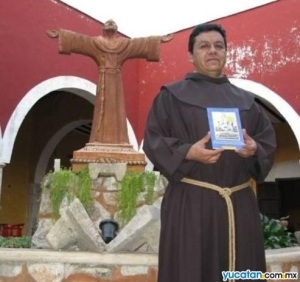 |
| Fray Tomas Gonzalez |
Also detained was migrants' rights defender, Ruben Figueroa. A state police officer beat Figueroa when the men refused to get out of their truck. As they were beating him, they told him, "We will teach you some respect."
The men told the police and soldiers that they are participating in the "Peace Caravan" led by poet Javier Sicilia. The agents responded, "What caravan?"
Amnesty International reports that later, a man in a white pickup truck with license plate number RB94861 stopped nearby and yelled at the police and military, "Take him away!" The man yelled at Fray Tomas, "Conniving Indian! You're worthless!" and "Here there aren't any witnesses, I'm going to kick the shit out of this jerk."
Fray Tomas has repeatedly denounced authorities' complicity with the drug cartels that pray upon Central American migrants who pass through Mexico to reach the United States. Friday night he stated that despite a recent purge in the government's National Migration Institute (INM), immigration agents are still in collusion with drug trafficking organizations. The purge occurred because immigration agents were detaining migrants and handing them over to drug cartels.
Fray Tomas was one of the organizers of the Peace Caravan event in Palenque, Chiapas. There, in an interview, he stated that he told authorities fifteen days ago that he knows where 40 migrants are being held hostage by criminals in Tabasco. He said he offered to accompany authorities to the house where they're being held, and authorities refused to act.
Fray Tomas has received threats for his work with migrants, the most recent being a death threat last week. The National Human Rights Commission ordered that the government provide him with "protective measures," that is, a police escort. The government has not complied with this order, forcing Fray Thomas to take his case to the Inter-American Human Rights Commission, where it is still pending.
A version of this blog was first posted on Kristin's blog at: http://mywordismyweapon.blogspot.com/2011/09/breaking-fray-thomas-gonzalez-detained.html
Sep 14, 2011
Movement for Peace with Justice: MEXICO: Peace Caravan "Has Made Us Feel Stronger"
IPS ipsnews.net: "OAXACA, Mexico: With a hug Olga Reyes from Chihuahua, who has lost six family members in Mexico's wave of drug-related violence, greets Araceli Rodríguez from Mexico state, the mother of a young federal police officer who "disappeared" in Michoacán two years ago.
They are both travelling with the Peace Caravan, heading for Mexico's southern border with Guatemala....
Led by poet Javier Sicilia, the caravan is headed south to pick up supporters of the movement, which opposes the militarisation of the country in the fight against drug trafficking. On the fourth day of the caravan's progress, Sicilia was welcomed with flowers and incense by people from 16 indigenous communities at the ancient Zapotec ceremonial centre at Monte Albán in Oaxaca state.
"This caravan is strengthening awareness and strengthening hearts, and it is making people stand up tall," said Carmelina Santiago, of the Flor y Canto Indigenous Rights Centre.
The procession of vehicles, which left Mexico City Friday Sept. 9, is going to Ciudad Hidalgo in the southern state of Chiapas, which borders Guatemala, to apologise on behalf of all Mexicans for the murders of Central American migrants."
They are both travelling with the Peace Caravan, heading for Mexico's southern border with Guatemala....
Led by poet Javier Sicilia, the caravan is headed south to pick up supporters of the movement, which opposes the militarisation of the country in the fight against drug trafficking. On the fourth day of the caravan's progress, Sicilia was welcomed with flowers and incense by people from 16 indigenous communities at the ancient Zapotec ceremonial centre at Monte Albán in Oaxaca state.
"This caravan is strengthening awareness and strengthening hearts, and it is making people stand up tall," said Carmelina Santiago, of the Flor y Canto Indigenous Rights Centre.
The procession of vehicles, which left Mexico City Friday Sept. 9, is going to Ciudad Hidalgo in the southern state of Chiapas, which borders Guatemala, to apologise on behalf of all Mexicans for the murders of Central American migrants."
Movement for Peace with Justice: Guerrero Protesters Demand Education, Not War
AmericasProgram: "Several thousand people marched on Acapulco, Guerrero, this past Saturday chanting, “We don’t want war, we want education!” The march occurred during poet Javier Sicilia’s visit to the seaside city as his caravan of drug war victims makes its way to the Mexico-Guatemala border."
Jul 1, 2011
Movement for Peace with Justice: Mass Protests Finally Incite Public Discussion About The Drug War’s Forgotten Victims
From the New Republic, a look at the personal experiences motivating the Caravan for Peace and the public dynamic that has been created as a result.
Mexico: Mass Protests Finally Incite Public Discussion About The Drug War’s Forgotten Victims | The New Republic: "“What the movement has done is open a period in which the victims have had the opportunity to recount their stories, transcending their anonymity by speaking,” argues Edgar Cortez, an investigator at the Mexican Institute of Human Rights. “[But] the crucial point is, what do you do with that?”
Yet its first step has been a huge one: breaking the public’s silence over the drug war. That alone is magnetic for the countless people in Mexico who have suffered in recent years. “What I know is that this movement has to continue and it has to be pacifistic,” said Robert Galván, (whose son disappeared in January).... “Because, when we fight violence with more violence, everything simply falls apart.”"
Mexico: Mass Protests Finally Incite Public Discussion About The Drug War’s Forgotten Victims | The New Republic: "“What the movement has done is open a period in which the victims have had the opportunity to recount their stories, transcending their anonymity by speaking,” argues Edgar Cortez, an investigator at the Mexican Institute of Human Rights. “[But] the crucial point is, what do you do with that?”
Jun 23, 2011
Movement for Peace with Justice: Mexico's Calderon agrees to reconsider drug war strategy
Another take on the meeting between Javier Sicilia and Mexican President Calderon
After more than three hours of dialogue with Javier Sicilia, who heads the Movement for Peace with Justice and Dignity, and victims of violence, Calderon said he was open to 'reviewing' his security strategy.
He also accepted Sicilia's proposal to create a commission to 'work on behalf of the victims' as well as on a new security strategy.
The president likewise agreed to meet again in three months with the poet, whose son was murdered by gangsters in late March.
'I'm willing to make changes,' said Calderon, who added that to do so he would need to 'see clearly' the direction in which to direct his strategy to fight organized crime, an effort in which the military is playing the central role."
Movement for Peace with Justice: Can Mexico's Peace Movement Change Calderon's Strategy?
Can Mexico's Peace Movement Change Calderon's Strategy?: "The president, and some members of his cabinet, will meet with 35 representatives of the Movement for Peace with Justice and Dignity. Many of them have lost relatives to drug violence, including poet Javier Sicilia, whose son was murdered in March by a gang. Since then the high-profile writer has led the campaign for peace, including a march across the country to Ciudad Juarez, Mexico's most violent city.
The meeting was originally slated to take place on Thursday, June 23 at the National Museum of Anthropology, a location that the group had selected as symbolic of the “national re-foundation” that the country needs. However, at the last minute officials changed the location to the Chapultepec Castle, according to El Universal. Presumably the switch was made for security reasons, in an effort to limit the chances of the meeting being disturbed by protests.
Mexico’s Interior Ministry confirmed the meeting, saying that the government has been seeking input from civil society “since the beginning of the implementation of the National Security Strategy.” This has been refuted by Sicilia and others, however, who have complained that their calls for a national dialogue have fallen on"
The meeting was originally slated to take place on Thursday, June 23 at the National Museum of Anthropology, a location that the group had selected as symbolic of the “national re-foundation” that the country needs. However, at the last minute officials changed the location to the Chapultepec Castle, according to El Universal. Presumably the switch was made for security reasons, in an effort to limit the chances of the meeting being disturbed by protests.
Mexico’s Interior Ministry confirmed the meeting, saying that the government has been seeking input from civil society “since the beginning of the implementation of the National Security Strategy.” This has been refuted by Sicilia and others, however, who have complained that their calls for a national dialogue have fallen on"
Movement for Peace with Justice: Citizen’s Pact for Peace with Justice and Dignity
Here is the Americas Program's translation of the "Citizen's Pact for Peace and Justice" signed in Ciudad Juárez by participants at the end of the recent Caravan for Peace with Justice and Dignity.
Jun 22, 2011
Movement for Peace with Justice: Poet to meet with Mexico's president, demand new drug war strategy
Poet to meet with Mexico's president, demand new drug war strategy - CNN.com: "A Mexican poet who leads a popular anti-violence movement will demand a change in the nation's crime-fighting strategy when he meets with President Felipe Calderon this week, activists said.
Poet Javier Sicilia and other members of his group will request specific responses about modifying Mexico's approach to national security, human rights advocate Emilio Alvarez Icaza told reporters Tuesday.
They will also call on the Mexican government to devote more attention to victims of violence, Alvarez said."
Poet Javier Sicilia and other members of his group will request specific responses about modifying Mexico's approach to national security, human rights advocate Emilio Alvarez Icaza told reporters Tuesday.
They will also call on the Mexican government to devote more attention to victims of violence, Alvarez said."
Movement for Peace with Justice: Video from the Caravan for Peace with Justice and Dignity – CIP Americas
Documentary video from the Americas Program
Jun 15, 2011
Movement for Peace with Justice: A Photo Essay from the Caravan for Peace with Justice
Here is a powerful photo essay of the Caravan for Peace rally in Ciudad Juárez. As the saying goes, "A picture is worth ...."
KT Photography: "It’s a long and lonely walk over the Rio Grande and not knowing what I’m about to face on the other side makes it even more lonely. Juarez Mexico is now crowned the most dangerous place on earth.
I wanted to be there for the final day of Javier Sicilia’s 7 day Peace March, Sicilia is a famous poet and journalist in Mexico and his son was murdered last March by the drug cartels. He was an innocent victim; in the wrong place at the wrong time, like so many others. I managed to connect and contact the right people, got myself a media pass and booked my flights to El Paso and was promised by the rally organizers and a local journalist they would take good care of me. And so they did." read more
KT Photography: "It’s a long and lonely walk over the Rio Grande and not knowing what I’m about to face on the other side makes it even more lonely. Juarez Mexico is now crowned the most dangerous place on earth.
I wanted to be there for the final day of Javier Sicilia’s 7 day Peace March, Sicilia is a famous poet and journalist in Mexico and his son was murdered last March by the drug cartels. He was an innocent victim; in the wrong place at the wrong time, like so many others. I managed to connect and contact the right people, got myself a media pass and booked my flights to El Paso and was promised by the rally organizers and a local journalist they would take good care of me. And so they did." read more
Movement for Peace with Justice: "An Attitude of Soul"
A view of the Caravan for Peace with Justice from a member of the Fellowship of Reconciliation
The stories broke open hearts, and in turn opened stories of those whose hearts were already broken. “We have seen a sea of dignity,” said one of the participants."
Movement for Peace with Justice: Sister cities unite for peace
Students at the University of Texas at El Paso participated with their neighbors from Ciudad Juárez in last weekend's Caravan for Peace with Justice rally at the border .
'This is important for our communities and being a part of this caravan shows support and solidarity with the victims of the drug war,' said Ana Morales, one of the organizers of the event and graduate student in sociology. 'Being in El Paso makes us comfortable, but, in reality, we are all in Juárez.'
Several UTEP student organizations such as MEChA (Movimiento Estudiantil Chicana/o de Aztlán), MASS (Mexican American Student Society) and Miners Without Borders, as well as alumni, participated in the rally.
"It was an amazing experience," said Saray Argumedo, senior print media major. "When we were crossing the bridge, a line of activists already in Juárez waiting for us, said, ‘welcome back to your home.'"
Many of the individuals attending the event said the movement is not just about protesting the drug war violence, but about injustice and the many social struggles and inequities plaguing Mexico.
"This peace movement is the first to directly criticize military involvement of the Mexican government, and it's also critiquing American policy in Mexico like the Merida Initiative, which is funding not only military injustice, but cartel injustice," said Sean Garcia, a senior English and American literature major."
Subscribe to:
Posts (Atom)